
Microserfs is a novel that follows the lives of a group of computer-geeks, former Microsoft employees, as they journey into developing their own software design business. The novel is composed of a series of journal entries of the main character, Daniel, who seeks to understand himself through recording the daily events of his life as well as those of his friends and family. A major subject that often arises amongst them is the blurring between physical human bodies and machines, and their conflicting desires to disconnect the two, while at other times, merge them together. Through the course of the novel, they truly become humans through developing emotional and physical connections with their own bodies and to the bodies of others. The merging of bodies and machines into the techno-body is shown to be equally as beautiful when at the end, Dan’s mother is left in a vegetative state after a stroke and they connect her to a computer to allow her to communicate with them. Since their journey to this point was only possible through their own capitalistic pursuit, or living “the American dream”, contrasting it with the concept of Taylorism, as discussed by Charles S. Maier, can demonstrate how capitalism is viewed as the protector of humanity against inhuman treatment and the liberator of technological innovation by means of necessary class formation.
Continue reading
Microserfs: Living the American Dream
Filed under Novel response, Student Postings
Coupland + Microserfs + Novel Response …drove into the flower-scented, gasoline-powered California night
Microserfs, a novel written by Douglas Coupland in 1995 exemplifies several aspects of the Taylorist economic management as well as the attendant form of social organization as discussed in Maier’s 1970 article entitled “Between Taylorism and Technocracy: European ideologies and the vision of industrial productivity in the 1920s”. While there are a number of sections which exemplify scientific management, as well as the concept of a worker striving to increase production for the benefit of increased reward, the section from pages 260 through 300 contain the most overt references to these concepts. Although at first glance Microserfs may appear to be a reference to those who work for Microsoft as explained on page 89 the term actually refers to the answer you give to “Are you One-Point-Oh?” The answer to this question, Coupland says, is what “separates the Microserfs from the Cyberlords.” It is interesting to note that while in the beginning of the book this represents an overt sense of class system amongst the “nerd” community, by the time we reach the middle to end of the novel the character’s view and understanding of the social strata in which they exist changes.
Continue reading
Filed under Novel response, Student Postings
Microserfs: Exploring Identity
Coupland’s book Microserfs followed the lives of Microsoft employees as they tried to uncover who they were beyond their technical skills and the roles they played as employees. As the characters progressed and ventured into new experiences, the theme consistently arose on the importance of the human body compared to the conscious, and the connections these two matters have with each other. Another topic that was addressed by the novel was human’s relationships with the natural, how we compare to animals. Questions were asked along the lines of, “what makes us different than animals, or special?”.
Continue reading
Filed under Novel response, Student Postings
The Moral Panic of a Microserf
The book Microserfs is about 6 characters that all work for Microsoft as serfs under Bill Gates, whom they all worship. The book is told through multiple diary entries from the main character Daniel who starts out as a software tester for Microsoft, but later becomes a programmer when working on the Oop! (Object Oriented Programming) project. He and his five roommates Karla, Abe, Todd, Susan and Bug Barbeque all are facing the issue of trying to have a life outside of their computers. This creates what is referred to as moral panic in Giselinde Kuipers’ article, for all of them because they are not really sure how to go about doing this for themselves; moral panic is the idea of something threatening societal values and interests a person holds, and is typically represented by the mass media (2006, p. 380).
Continue reading
Filed under Novel response, Student Postings
The Makers: The ‘New Economy’ and the Myth of ‘Ownership’
Did you know that Cory Doctorow, author of The Makers, provides his novel for free online? If you were ahead of the game, unlike I am, you would have downloaded it for free instead of paying for it on your E-reader. Why, you may ask, would the author of a book, who is entitled to copyright royalties, upload his novel on the Internet? It is because Doctorow is a believer in the ‘New Economy’, a more creative approach of a bottom-up, unregulated, and decentralized economy (15-20). This new financial framework is a fundamental structure that drives the creative industries in The Makers, and evolves in the book through multiple transformations, mainly around the ‘New Work’ era.

Working gnomes by Horia Varlan
The ‘New Work’ era in the novel is exemplified as a structure that takes the place of neoliberal capitalism. After the dot-bust and the economic crash, new networks of small creative entrepreneurs were funded by large institutions such as Kodacell, and worked as small decentralized groups in the ‘New Economy’ (12-15). These groups, such as Perry and Lester’s, created systems of shantytowns, crowd-sourced technologies, an unregulated amusement park franchise, and investment litigation ventures. The ‘New Work’ economy is lamented in the book as being able to “all come together to execute, without a lot of top-down management. The bangbangers arms dealers, the bioterrorists and fatkins suppliers – they all run on… a fluid social institution that you couldn’t have ten or fifteen years ago” (137). The ‘New Economy’ is constructed as a utopian vision of communal participatory members, all working as a fluid self-regulated social organization without the omnipresent corporations, no concentration of capital, and certainly no Intellectual Property legislation.
Continue reading
Filed under Novel response, Student Postings
The Semantic Void: History of ‘Technology’ meets Story in Makers
Cory Doctrow is a something of a guru when it comes to being on the inside of technological know-how. His ‘regular’ job as editor of Boing Boing sets him up beautifully to imagine our future as consisting of and based on relationships with future technologies, which he brings to life in his 2009 novel Makers, the rather frenetic tale of a pair of inventors and the people that surround them. While there are numerous narratives and potential avenues of analysis that populate this book, the consistent focus that permeates the novel for this reader is the question of what ‘technology’ means. Is it a means of enhancing daily life, or a way of living? Does it shape the world, or the people who live in the world? When does invention become entrepreneurship, and when does it constitute ‘selling out’? These are the types of diverse, complex questions that this novel raises, and for the most part, tries to answer.
For the purposes of this response, the most relevant question is the overarching query of what ‘technology’ means in the fictional world of Makers where lumbering, outdated corporations crumble and the pieces are picked up by thousands of miniature start-up endeavors. Lester and Perry Gibbons, the dynamic duo that start out so innocently as eccentric inventor-types working out of an abandoned junk-yard, come to grapple with questions drastically more difficult than the childish, carefree image of technology as pure innovation that they originally represent in Doctrow’s uncomfortably recognizable vision of the future. Another, more literal narrative concerning technology comes from Leo Marx, whose historical perspective traces the meaning of the word from inception to present. His assertion is that the word ‘technology’ came into its present meaning in our culture organically, through a natural process of requirement for its definition; “…the emergence of technology as a keyword in the lexicon we rely on to chart the changing character of society and culture.” (Marx 563), like the meaning of the word ‘culture’ itself, changes with the lived manifestation of the concept (March 563).
Continue reading
Filed under Film response, Student Postings
The Makers and the Managers: A Novel Response to Cory Doctorow’s The Makers
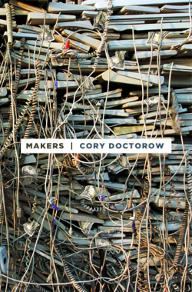
Makers, retrieved from http://craphound.com
In Cory Doctorow’s Makers (2009), there is a continual tension between artisanal creativity and business-oriented goals of profit and utility. This tension might be best contextualized in the following antinomy: The urge to create—at least, in its pure state—is not the advancement towards some teleological ends, it is an ends itself it is “l’art pour l’art”—this is the principle of renewal, generation, growth and life—creation is nature. By contrast the urge to generate wealth and create value is pragmatic, scientific, conservative, worldly and based upon causal interactions all directed towards a foreseeable goal—in this way, utilitarian business ethics resemble the function of culture. Nature in an oppositional stance can represent destruction—think of earthquakes, tidal waves, flooding, and predatory animals—but in this destruction also exists the seeds of creation, renewal, regeneration and change. Culture also is capable of being its opposite: frivolity, excess, irrationality, liberality, isolationist and meaningless—but these states too allow for the regeneration of culture via a kind of re-evolution or mirroring effect. Revolution after all, literally means returning to the point of the circle from which the movement began. Where creativity and business meet—in this liminal space between culture and nature—is where we are apt to witness what might best be described as successful ‘economic revolutions’. In Hegelian terminology, thesis (creativity) combines with antithesis (business), creating a harmonized synthesis that enables economic prosperity (for a time).
Continue reading
Filed under Film response, Student Postings
Art vs. Commerce: “Makers” and the “Information Society”
“Makers”, by Cory Doctorow (2010) puts a new spin on the “arts vs. commerce” debate, in order to uncover whether the distinction between the two is a clear cut some artistic purists would like to think. The novel follows the lives of Perry and Lester, two “inventors” with an incredible knack for turning forgotten technology into innovative and creative products, Landon Kettlewell, a financier with aims to capitalizing on their creativity, and Susan Church, the reporter tasked to capture it all. In actuality, the novel is an informative exploration of the changes to capitalism that occur as a result of rapidly advancing technology and the role business and marketing play in this new organizing system. There are several elements of Nicholas Garnham’s (2005) article about the shift from the “cultural” to the “creative” industries that can be taken up and discussed in relation to the novel.
Continue reading
Filed under Film response, Student Postings
Hacking Into Normalization
The film, Hackers, completely and fully embodies the sense of a social construction of online dangers and normalization as found in the article by Giselinde Kuipers. The concept of the “Hacker” as a danger is established within moments of the film’s opening, with a young Dade being legally prosecuted for crashing over one thousand computer networks, a fact that is recited numerous times during the film. This scene works to establish the hacker identity as a social rebel who is a danger to society and to himself and the act of hacking as harmful to the overall well being of society. Throughout the film, the concept of the hacker is further fleshed out, suggesting that a hacker is rebellious, social deviant, who rejects the social norms and expectations at all costs, finding enjoyment in subverting the law, and interested in only indulging his own enjoyment. The hacker is also painted as a technical wiz who is able to control and manipulate technology to fulfill any of his needs at any time.
Filed under Film response, Student Postings
Chatrooms Resulting in Moral Panic
The development of online chatrooms has opened up a whole new form of online communication, allowing for quick messaging, and the creation of online communities. There are positive outcomes resulting from the creation of online chatrooms, such as, the formation of communities and support groups, and quick and efficient communication. However, despite these benefits to chatrooms, there has been a development of various social anxieties around this form of online communication. The film Chatroom presents an example of where these social anxieties have developed from, as well as, demonstrates some of the dangers with online interaction through chatrooms.
Continue reading
Filed under Film response, Student Postings


 imaginethenet